Unlock the secret to thriving indoor plants with our expert guide on selecting the perfect pot.
Why premium plant rental changes how your space feels
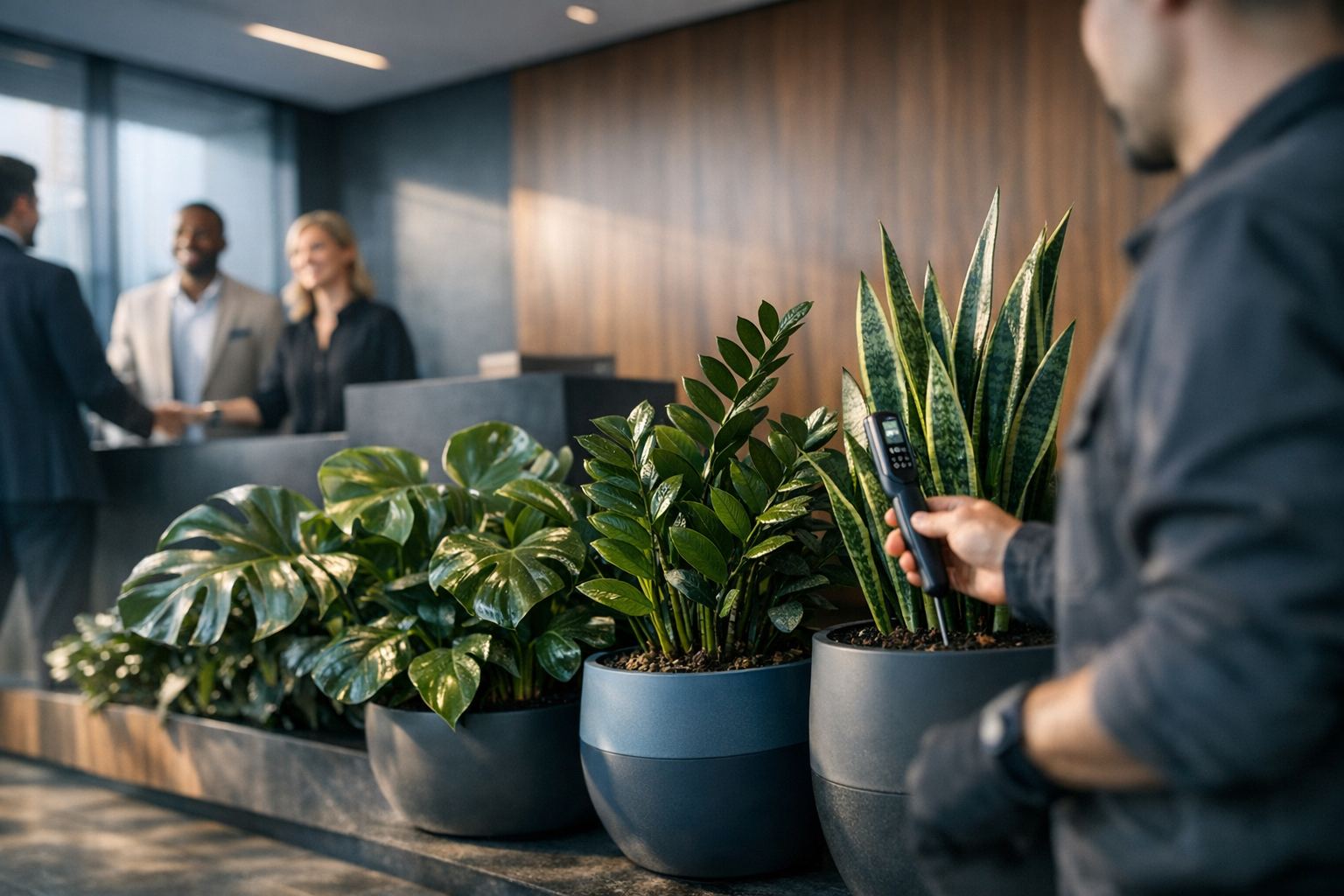
Premium plant rental with ongoing care gives client-facing businesses museum-level greenery without adding work to staff by combining curated, high-impact specimens with professional maintenance that keeps every plant looking freshly installed, day after day.
When clients step into your space, they start forming opinions before anyone speaks. Plants are one of the fastest ways to shape that first impression. A mature ficus anchoring a reception area or an architectural palm at the end of a corridor instantly tells visitors that your environment is intentional, not improvised.
For law firms, financial practices, and luxury real estate offices, that visual story matters. Clients are trusting you with life-changing decisions. When your space looks cared for, it reinforces the idea that you care about the details elsewhere too. The key is consistency: a single wilted planter can undermine months of design work.
This is where ongoing care becomes non‑negotiable. Watering, pruning, pest checks, and rotation are all invisible when they are working—and glaringly obvious when they are not. A premium rental program bakes these tasks into the service, so the plants never quietly become another to‑do on a busy office manager’s list.
Consider the difference between a DIY approach and a curated rental. In one Boston financial advisory office, a row of mismatched planters along a glass wall slowly turned into a maintenance headache. Staff watered on different days, a few plants yellowed, and the overall effect drifted from "designed" to "accidental." After switching to a coordinated plant rental with scheduled care, the same corridor became a cohesive green backdrop that partners now use for client walkthroughs.
Beyond appearance, plants also affect how a space feels to work in every day. Studies have found that plants in offices can increase perceived well‑being and reduce stress for employees, especially in high‑pressure environments where people spend long hours indoors. When those plants are consistently healthy, the effect is subtle but steady—a calmer, more grounded atmosphere for both teams and clients.
Importantly, premium rental shifts plant care from an internal chore to an external promise. You are not just buying greenery; you are securing a commitment that the environment your clients see on day one will still look intentional and well kept on day one hundred.
What actually makes a plant installation feel truly luxurious
A luxury plant installation isn’t just about expensive species; it is about the layered qualities that make your space feel curated rather than decorated: rarity, form, maturity, provenance, and context working together in a specific environment.
Rarity and exclusivity often provide the first signal. Plants that are slow to grow, difficult to propagate, or native to a limited region immediately read as considered choices. A mature cycad that took years to reach its current size or a variegated specimen with one‑of‑a‑kind patterning will feel different from a common, mass‑produced cultivar.
Form and presence are just as important. Luxury clients tend to respond strongly to plants with architectural lines: multi‑trunked trees, oversized foliage that frames a seating area, or a perfectly symmetrical specimen anchoring a lobby. These plants do more than fill space; they shape how people move through and experience the room.
Age and maturity introduce another dimension of quiet prestige. A thick‑trunked olive tree or a decades‑old indoor palm carries its history in the bark and branching. In a model unit or private bank lobby, that sense of "living artifact" can subtly echo the long‑term perspective you bring to client relationships.
Cultural and provenance stories deepen the impact. Orchids gained their association with wealth in Victorian England. Bonsai workshopped over generations are respected as living sculptures. When your greenery is selected with those narratives in mind—whether it is a collector‑lineage specimen or a species historically tied to refinement—it contributes to the story your space tells.
Then there is craftsmanship and context. Containers, substrates, and placement all matter. A cloud‑pruned topiary in a handcrafted vessel will feel entirely different from the same plant in a standard fiberglass pot. Thoughtful underplanting, sightline planning, and lighting transform individual specimens into a cohesive experience that feels designed rather than assembled.
For client‑facing businesses, the most effective luxury installations are rarely the most flamboyant. They are the ones where every element feels intentional: nothing is an afterthought, and nothing looks fragile or fussy. A curved reception desk backed by a series of tall, consistent silhouettes, for example, can create a dignified frame for every conversation that happens there.
Premium rental with ongoing care allows these elements—rarity, age, craftsmanship—to shine over time. Without expert upkeep, even the most distinctive plants can quickly slip out of alignment with the rest of your design.
How to choose a plant partner who protects your team’s time
Choosing the right plant rental and care partner means looking beyond species lists to the systems, expertise, and service rhythms that will keep your space looking intentional without adding work to your team.
Start with alignment on motivation. If your primary goal is impression management and environment design, your partner should be fluent in how plants support client‑facing spaces—not just how to keep them alive. They should talk about sightlines in reception, how greenery frames key seating areas, and how mature specimens can support brand perception.
Next, look closely at curation. Ask how they select plants for law firms versus boutique hospitality, or for a glass‑walled conference floor versus a quieter consultation suite. Strong partners will be able to explain why they recommend a slow‑growing, sculptural specimen at the end of a corridor instead of a fast‑spreading, maintenance‑heavy option.
Service model is just as critical. A premium offering should include scheduled visits for watering, pruning, pest monitoring, and rotation. It should also have clear protocols for plant replacement so that a stressed specimen is swapped proactively before it detracts from your space. You should leave the walkthrough knowing exactly who is responsible for what—and that "your staff" is never the default answer.
To protect your team’s time, ask practical questions: Who has keys or access to your space? How are service windows coordinated around client meetings? How will they communicate if a plant near a drafty window needs to move, or if a lobby specimen is outgrowing the original container? Clear processes here prevent last‑minute disruptions.
Request examples from similar businesses. A partner who has supported a managing partner’s office, a private banking branch, or a design studio will be able to share specific layouts and before‑and‑after outcomes. Look for stories where staff felt relief as well as pride—where the plants stopped being a worry and started functioning as part of the firm’s visual identity.
Finally, consider the long‑term relationship. Premium rentals often make the most sense on multi‑year horizons, especially in spaces used to close deals or host repeat clients. A partner who tracks how your plants are performing season to season—and suggests quiet refinements rather than constant overhauls—will help keep your environment timeless rather than tied to a passing trend.
When you find the right fit, your plant program becomes one less thing to manage. Your space continues to tell the story you want it to tell, and your team stays focused on the work only they can do, while every leaf and branch quietly reinforces the standard you hold for your clients.